AI is booming. So are the services around it. In the market everyone is focussing on making sure that their content is AI ready. This means rewriting pages, adding structured data and fixing the terminology. It's fundamental step but we are missing a bigger chunk of it at the moment.
The short answer
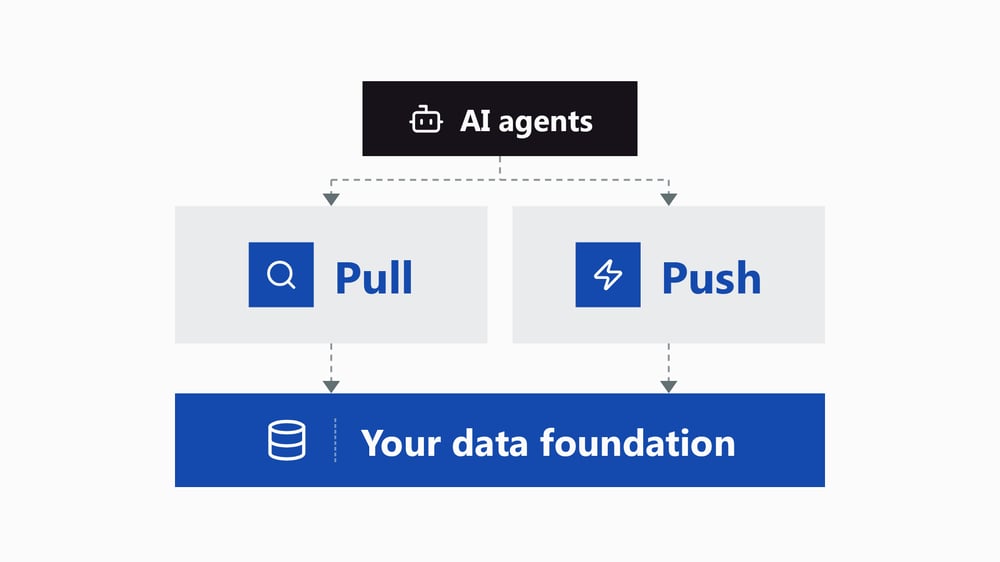
Making sure you are visible for an AI agent is based on two steps. It all start with the pull. Which is an agent that visits your website. He reads and indexes content. This is almost solely content and mark up job. The other one is call the push. You as an organisation expose data and actions via interfaces and an agents calls it directly. This is a data fundament step.
The Agentic Commerce Protocol is still in beta. It published 5 releases between 29 September 2025 and 17 April 2026.
In short
- The Pull is for agents that crawl and read your content. Make sure you structure your data correctly and is has clarity and an evidence to be trustworthy.
- The push for agents is to make sure that data and their actions are reachable. This requires consistent structure that is timeless and has limits for an agent what it is permitted to do.
- The pull is the hygiene layer. It is necessary to be found but it is not sufficient to be chosen.
- The Agentic Commerce Protocol has a lot of releases between 29 September 2025 and 17 April 2026 and is still in beta.
- The protocol layer is still not there yet. Therefore a investment is in the layer underneath. The datafundament that produces consistent, current and permissioned output regardless of the model is the best step.
What is pull and what does it require?
The Pull is an discovery phase but then passive. When an agent visits your website. It reads it and makes sure it creates a good representation of what you are and what your offering is.
The requirements aren't that sexy and are more likely a good old back in the days SEO task. You write for humans and creating the structure for the machine. If you use consistent sections and terminology you are going to be good at it. But be explicit about who you are and your offers. Divide it in correct pages with substantiate claims where you also show the last update version of it.
Try it and an agent can find you and is trying to show you in the answers. This is what we call a hygiene layer. It's making sure you are part of the agents consideration. It's not always get you chosen and it does not let an agent do anything on a customer's behalf.
What is push and why is it different?
Now about the push. This is making data and actions directly usable.
For this push phase the requirements are a fixed and predictable structure that can be used without guesswork; a design for external use. All the updates are or near real time or realtime for anything that influences a decision. An explicit definition of what an agent is allowed to do with what you expose.
Every one of those is part of a data fundament. An organisation with excellent content and a data foundation built around its own internal exceptions cannot do a push and there is no amount of editorial work changes that.
The distinction matters because the two halves have different owners. Pull is part of the marketing and content team. The push parts belongs to the data and engineering teams.
Why building against a specific protocol is the wrong investment
The protocol is in the phase of definition of done. It is still moving but that data fundament underneath it isn't. So you can already start to step up your game
Something that is called: the agentic commerce protocol is an open standard for connecting buyers, their own agents and business with OpenAI and Stripe (or managed by). This protocol is using date-based versioning. Its has a couple of releases already and the latest so far is the one on the 17th of April 2026. In this last versions they added order and authentication endpoints and feed capabilities for product discovery. But also this last version is still in BETA. And this is not the only one because competing protocols from other platforms exist as well.
There were 5 revisions in a year means we are not there yet and it means that choosing for one of the protocols is not the best bet in town.
A good example of this is the Instant Checkout in ChatGPT. This is built on this protocol and launched in the US in 2025. But in march 2026 we already got the message that this feature was (at least) temporarily pulling back from promoting purchases directly in ChatGPT. So if you started to build everything for that instant checkout you had spend a lot of time and money building for something that was withdrawn a few months later. If a similar organisation spent the same period making its product, price and availability data consistent this would still have the same value and/or even more.
So what did we learn from this the stable part is the data fundament. Whichever protocol it is going to be. It will always ask for the same thing: a consistent data fundament where you have all the information of your products or services available. Something that fits all protocols. So build that and adopting the next big thing which can be a new protocol becomes an integration project for a couple of weeks with a small budget scope.
What this means for you
Separate the two steps and test the second one before you buy into a standard.
- Split the work into a pull track and a push track with an owner for each.
- For pull, audit for structure, explicitness, evidence and dating, and ignore format claims that no crawler documents honouring.
- For push, take one commercially relevant entity, such as a product with availability, and write down its external representation without internal codes, exceptions or legacy fields.
- Measure how current that representation can be. If availability refreshes nightly, that is the ceiling for every decision an agent makes on it.
- Write the permission statement before the integration: which external parties may read what, at what frequency, for which purposes, and what happens when that is exceeded.
Key points
- Agent readiness is two problems: pull, which is a content and markup problem, and push, which is a data layer problem.
- Pull is a hygiene layer that makes an organisation findable and interpretable, and it is not sufficient to influence a recommendation.
- Push requires consistent external representation, near-real-time currency, and an explicit statement of what an agent may do.
- The Agentic Commerce Protocol published 5 releases between 29 September 2025 and 17 April 2026 and remains in beta, so protocol-specific integrations are depreciating assets.
- In the Netherlands, collection is supervised by the Autoriteit Persoonsgegevens under Article 11.7a of the Telecommunicatiewet and the GDPR, while exposure and portability fall to the Autoriteit Consument en Markt under the Uitvoeringswet dataverordening, in force since 21 November 2025.
FAQ
About the author
Brent Stevens is Commercial Director at Cloud Nine Digital, a Dutch data and analytics agency that builds and audits data collection layers. Cloud Nine Digital audited all 18 Eredivisie clubs on consent compliance in 2026, and 13 of them did not meet basic consent requirements. The agency is running a consent benchmark across 2,500 Dutch websites.
Cloud Nine Digital ranked first in the Data Science and Analytics Agencies category of the Emerce 100 in 2026, with 6 out of 7 stars, based on an image study by Motivaction among decision-makers in the Dutch market.
This article describes how Dutch consent rules interact with measurement configurations. It is not legal advice.