
Data Warehouse
More data doesn't automatically mean you need a data warehouse.
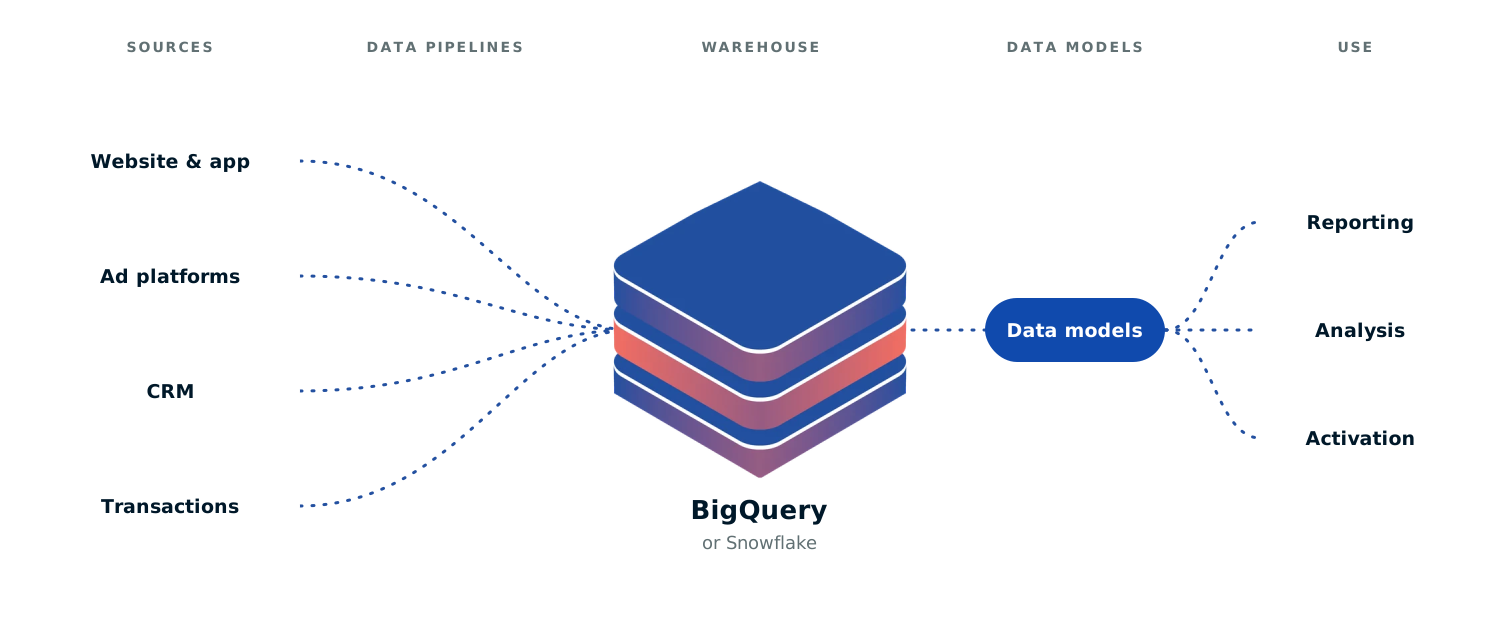
But when data is spread across websites, apps, advertising platforms, and internal systems, there comes a point when keeping it connected and usable becomes challenging. A cloud data warehouse gives that data one place to live and work together.
Built on Google BigQuery, or on Snowflake if you already run it.
A selection of our clients


Do we actually need a data warehouse?
Honestly, if you have a small number of data sources and straightforward reporting, a spreadsheet or a direct connection to your analytics platform is enough.
We mean that. We once advised an insurer not to replace its customer data platform: in the short and medium term, the return would have been negative.
Not yet
- A handful of data sources
- Reports that live inside one platform
- No need for history beyond what the platform keeps
Time for a warehouse
- Combine website, app, advertising, CRM, or transactional data
- Refresh reporting without repeated manual exports
- Use the same datasets across multiple reports or teams
- Keep and analyze history outside the source platform
- Prepare data for modeling, activation, or complex analysis
How it fits together:
One place to live and work together
Data pipelines bring information from each source into the warehouse and keep it updated as new data arrives. Every dataset moves through raw, staging and production layers with automated tests, so a broken source doesn't quietly reach your reports. Your data stays in a European region, every change is checked by a second specialist, and we never go live on a Friday.
"A form fill says nothing about whether it became a real lead, an opportunity or revenue."
Marketing was measured as form fills per euro of media spend. Whether those forms turned into pipeline lived in the CRM, out of sight of the campaigns.
→The campaign ID was already on every lead. We match on that, so no new form fields, CRM changes or website releases.
→A read-only connection pulls CRM data into the warehouse. Email addresses are hashed, currencies normalized.
→Raw, staging and production layers with automated tests before anything reaches a report.
Putting all your data in one place doesn't make everyone agree on what revenue, customer, or conversion means.
What drives the BigQuery bill?
You pay for two things.
1) Storage: how much data you keep.
2) Processing: how much data your reports, users and applications read.
Not the number of people in your company. Usually the second one is where the bill grows.
BigQuery isn't priced by how many people work at your company. What counts is how much data you store and how much your reports, users, and applications process.
How we build the warehouse affects that bill. A query that repeatedly scans a huge dataset costs more than one designed to read only what it needs
How we keep the bill down
What if we want to move our data later?
Some parts are easier to move than others.
We design with future portability in mind, but choosing BigQuery means choosing parts of the Google Cloud ecosystem. Snowflake comes with its own dependencies. We recommend the platform that fits your existing setup, requirements, and expected usage.
Modeling logic
Business definitions, relationships and transformation rules can be recreated elsewhere.
SQL and configuration
Differ between platforms and need translating.
Ingestion pipelines
Built around Google Cloud services and APIs. These are rebuilt or adapted when you move.
Who looks after it?
Your team, us, or a split. We agree who owns what based on the expertise you already have.
A warehouse isn't finished when it goes live. APIs change, source fields get renamed, new datasets arrive, and volumes grow. Someone has to keep up with that.
| Who does what | Your teamfull control | Sharedthe middle ground | Usfixed monthly, named team |
|---|---|---|---|
| Pipelines and failed loads | ○ | ● | ● |
| Access and permissions | ○ | ○ | ● |
| Platform changes and API updates | ○ | ● | ● |
| Cost monitoring | ○ | ● | ● |
| Warehouse maintenance | ○ | ● | ● |
| Data models and reports | ○ | ○ | ● |
● Cloud Nine Digital ○ Your team
Frequently asked questions
-
Can we keep Power BI?
Yes. Power BI can remain the reporting layer while BigQuery stores and processes the underlying data. We design the architecture around your existing sources, models, and reporting.
-
Does a warehouse replace GA4 and our other analytics platforms?
No. Platforms such as GA4 continue to collect and process analytics data. The warehouse gives you somewhere to combine that data with other systems and use it beyond the analytics platform.
-
Where do we start?
With the questions you want answered, not with the platform. We agree the requirements first, connect the core sources into a first working version, and add the rest once that is being used.

Cloud Nine Digital is a certified Google Cloud Partner. We resell Google Cloud services and design, build, and manage BigQuery environments.
Being a partner doesn't mean Google Cloud is automatically the right answer.
Not sure you need one?
Tell us which sources you're combining and what you report on. We'll tell you whether a warehouse is worth it yet, or whether a direct connection does the job.
Data Models and Definitions
Create clear technical definitions for the data used across your systems.
Read more
Analysis and Reporting
Turn the data in your warehouse into reports and analysis your teams actually act on.
AI-Ready Data
Prepare data structures and definitions for reliable use in AI applications.
Read more
Contact details
Cloud Nine Digital
Johann Siegerstraat 24
1096 BH
Amsterdam, Netherlands
T: +31 (0)20 787 1323
E: info@cloudninedigital.nl
Need something else?
Please do reach out. We are happy to help!